 Channels
 Features
 Integration
 Service
 Blog
Blog 

Previously sidelined, well-being at work is an aspect increasingly taken into account: for employees to perform at their best, they need to feel comfortable and fulfilled within their company.
It's thanks to this desire to change the vision of work as "drudgery" that the concept of happy management, or happiness in the workplace, was born. Straight from the United States, happy management has become a major issue, synonymous with maximized productivity and performance.
But what is it?
Born in the heart of Silicon Valley and initiated by American start-ups, happy management is a response to harmful working conditions and mistreatment of employees, revealing suffering and burnout. Increasingly democratized in France, today we pay more attention to the human aspect than to the "robot work" aspect.
Its principle is simple: to promote the well-being of the work team, so that everyone feels at ease and in their place, whatever their role within the company. Implementing happy management can involve a wide variety of actions: ensuring good internal communication, organizing pleasant workspaces, understanding and listening to each other, strengthening team cohesion with activities/events... The list goes on! Above all, happy management is about creating a friendly working atmosphere that encourages everyone to flourish.

What are the benefits of happy management?
Above all, happy management has an obvious and significant impact on employee morale. No longer seeing work as a burden to bear is the main objective of this concept. On the contrary, going to work every morning feeling motivated and taking pleasure in carrying out one's tasks in an environment in which one feels good makes all the difference. A happy employee will naturally be more committed to his or her work and contribute positively to the company's dynamic. Ultimately, it's an exchange of good practices between the employee, who evolves in a professional climate adapted to his or her needs, and the company, which reaps the rewards of this well-being: increased productivity and quality work.
The birth of new professions
This trend towards happiness in the workplace has already won over many companies, who have even gone so far as to create new positions linked to the concept. For example, there's the "Chief Happiness Officer" (CHO) or "Happiness Manager". Although these names may seem rather naive, the Chief Happiness Officer or Happiness Manager are very serious positions. Their aim is to put in place solutions and systems to ensure the well-being of company employees. In order to carry out his or her missions successfully, the CHO must take care to develop the social bond between the work team, by implementing various actions. As such, the CHO needs to have good interpersonal skills, the ability to listen and understand, as well as analytical and observational skills.

Our happiness tips
Organize regular events: to encourage and strengthen team cohesion, there's nothing more effective than sharing special moments together. Breakfast every morning as a team, meetings and brainstorming sessions on Mondays, themed evenings, aperitifs and restaurants on important dates, nature and mountain seminars... The choice is wide - it's up to you to be creative!
Taking the time to talk to each employee: emphasizing teamwork and team spirit is all well and good, but looking after each employee individually is just as important. To ensure that each employee feels at home and understood within the company, it's essential to take the time to talk to them, to encourage them, congratulate them or find solutions to their problems. Why not offer regular coffee breaks in small groups, so that employees can get together and communicate more easily?
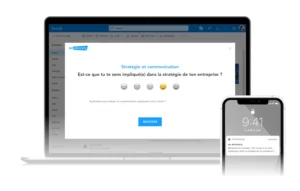
Encourage employees to take the initiative and listen to what they have to say: if you want your employees to understand you, you need to communicate with them in a way that allows them to express themselves freely and give their opinions without fear. To encourage initiative, why not set up an "ideas box", where everyone can share their impressions and remarks, and suggest improvements? Or you could always opt for the we advocacy solution, with its polling system that provides real-time feedback! 😉
Would you like to become a "Happiness Manager"?